
Who owns and operates Tokyo’s international schools?
When choosing an international school, parents often focus on curriculum, tuition, facilities, and university destinations. But there is another question that can be surprisingly difficult to answer: Who actually owns and runs the school?
Is it:
- A non-profit school governed by a board, with tuition and other revenue reinvested into the school?
- A privately owned school operated by an individual or family?
- Part of a corporate group that owns or oversees multiple schools?
This information isn’t always easy to find, and you can’t trust the first answer that AI gives!
The list below is based on my own research of publically available information, so there may be mistakes or outdated information. If you spot something that needs correcting, please let me know, and I’ll update it.
Why does ownership matter?
Ownership and governance can provide useful context when evaluating an international school. They can influence how decisions are made, how tuition revenue is used, who has responsibility for the school’s long-term direction, and how much control parents, school leaders, or an outside organization may have.
That doesn’t mean one ownership model is necessarily better than another. A non-profit school isn’t automatically better than a privately owned school, and being part of a corporate group isn’t necessarily a negative. The important thing is understanding how the school is structured and who ultimately makes the major decisions.
How I am categorizing the schools
Non-profit: Schools operated by non-profit organizations, foundations, associations, religious organizations, or other entities where the school is not owned by private investors and revenue is generally reinvested in the organization and its educational mission. These schools either identified themselves as non-profits on their websites or stated that they were registered as Gakko Hojin, a government-regulated status that requires being a non-profit.
Privately owned: Schools owned and operated by an individual, family, company, or other private entity.
Corporate group: Schools that are part of a larger organization that owns or operates multiple schools or businesses.
What I found
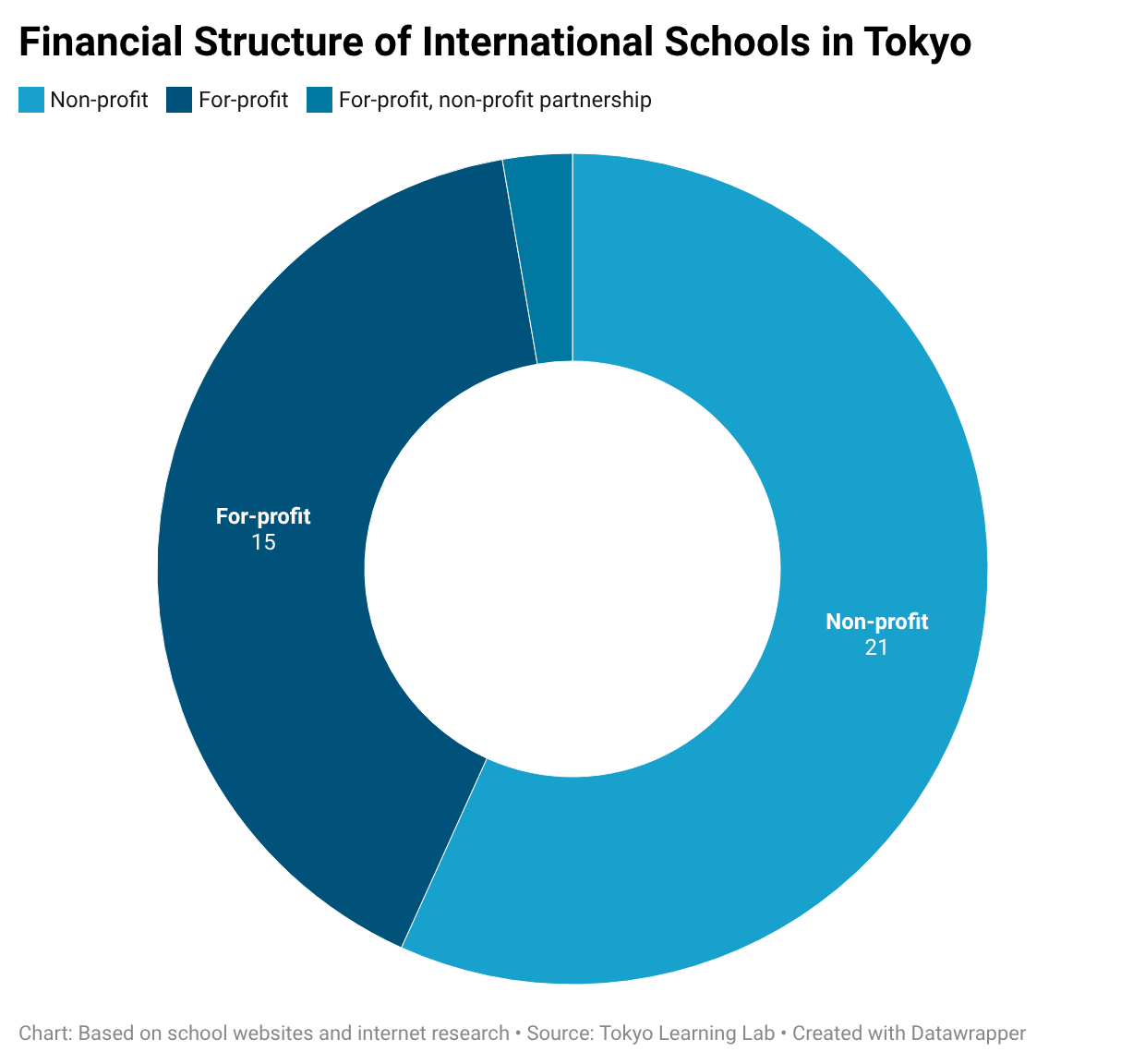
As expected, most of Tokyo’s large, established international schools are non-profits. I was pleased to see that non-profits make up the clear majority of the 37 schools on the list.
Privately owned schools are the second-largest group, while corporate-owned schools are the smallest.
Tokyo’s international school market remains relatively fragmented. While there are a number of privately owned schools, there is not yet the same concentration of large international school groups seen in some other international school markets in Asia.
| School | Status |
| American School in Japan | Non-profit, Gekko Hojin |
| Christian Academy in Japan | Non-profit, Gakko Hojin |
| Deutsche Schule Tokyo Yokohama | Non-profit (non-profit foundation with financial support from German and Swiss governments) |
| Horizon Japan International School | Non-profit, Gekko Hojin |
| India International School in Japan | Non-profit, Gekko Hojin |
| International School of the Sacred Heart | Non-profit, part of the Sacred Heart Gekko Hojin group |
| K International School | Non-profit, Gakko Hojin |
| Lycée Français International de Tokyo | Non-profit, Gakko Hojin |
| New International School | Non-profit, Gakko Hojin |
| Nishimachi International School | Non-profit, Gakko Hojin |
| Saint Maur International School | Non-profit, Gakko Hojin |
| Seisen International School | Non-profit, Gekko Hojin (operates under Seisen Jogakuin group of schools) |
| Shinagawa International School | Non-profit (stated on school website) |
| St. Mary’s International School | Non-profit, Gakko Hojin |
| The British School in Tokyo | Non-profit (operates under the Gakko Hojin of Showa Women’s University and Shibuya Kyoiku Gakuen) |
| Tokyo International Progressive School | Non-profit (stated on school website) |
| Tokyo International School | Non-profit (Gekko Hojin) |
| Tokyo YMCA International School | Non-profit (operates under Tokyo YMCA, a non-profit) |
| Yokohama Christian School | Non-profit (operates under Yokohama Union Church) |
| Yokohama International School | Non-profit, Gekko Hojin |
| Canadian International School | Privately owned |
| Capital Tokyo International School | Privately owned |
| EIFJ Tokyo French-Japanese IS | Privately owned |
| KAIS International School | Privately owned |
| TIF International High School | Privately owned |
| Tokyo West International School | Privately owned |
| UIA International School of Tokyo | Privately owned |
| United School of Tokyo | Privately owned |
| Yoyogi International School | Privately owned |
| Rugby School (day option) | For-profit, non-profit partnership (partnership between Rugby School in England and Clarence Education Asia, in cooperation with Mitsui Fudosan Co., Ltd. and Chiba University; registered as Gakko Hojin) |
| Global Indian International School | Corporate, Global Schools Group |
| Phoenix House International School | Corporate, Clarence Education Asia |
| Malvern College Tokyo | Corporate, Babylon Education Group |
| Aoba – Japan International School | Corporate, Aoba-BBT Inc. |
| Musashi International School Tokyo | Corporate, Aoba-BBT Inc. |
| Montessori School of Tokyo | Corporate, purchase by R.project in 2018; it is unclear if they still own the school |
Sources and methodology: Information was compiled from school websites and other publicly available sources. Ownership and governance structures can change, so this information should be considered a snapshot as of August 2026.
Ownership is only one factor when making a school decision
Ownership structure is useful information, but it shouldn’t be used as a proxy for school quality. A school’s ownership tells you something about its organizational structure, but it doesn’t tell you whether the school is a good fit for your child.
When comparing schools, parents should also consider curriculum, accreditation, leadership, teacher qualifications and retention, class sizes, student support, university destinations, facilities, and school culture.
If you would like some assistance on navigating the field of international schools in Tokyo, reach out to Matt Kish at [email protected]. I regularly advise families on finding the right school for their children, based on my 20 years of experience teaching and leading in Tokyo, London, Singapore, and the US.